What’s the Deal with Chess Clocks?
Chess clocks are essential tools for any chess club or tournament player but many new players find them intimidating mainly because they are not sure how they work or how to use them. Therefore, before we even get to the recommendations I think it’s a good idea to explain exactly what a chess clock is and how they work.
What is the Purpose of a Chess Clock?
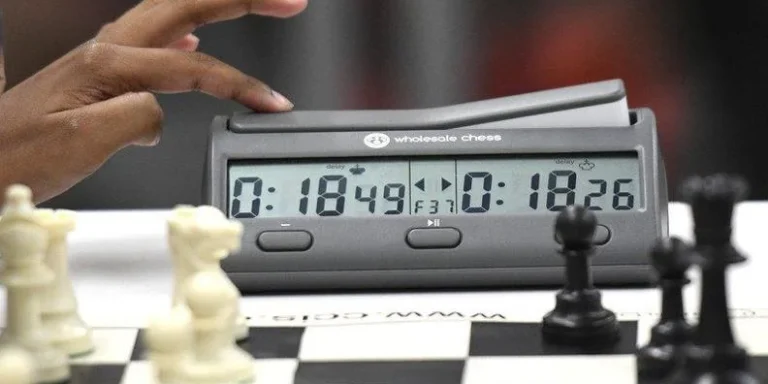
Chess clocks keep track of each player’s thinking time during a game and ensure that the game finishes in a specified amount of time. Before the invention of chess clocks, single games could go on for countless hours and even days and weeks. Chess clocks are basically just two countdown timers built into one box with one button for each player. Chess clocks simply give you a predetermined amount of time to complete all of your moves. The amount of time is for the entire game and you can use it however you want but if you run out of time, you lose.
How Does a Chess Clock Work?
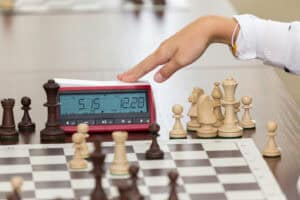
The player presses their button on the clock after each move they make and your turn is not considered complete until you have pressed your clock button. When a player presses their clock button, this starts their opponents clock counting down while simultaneously stopping their own clock. As a result, your own clock is only counting down while you are thinking and your opponents clocks is only counting down while they are thinking. When playing with a clock there are three ways to lose: resigning, being checkmated, or running out of time.
Special Features
It is important to mention that modern clocks sometimes have the ability for a few special functions: delay, increment, and move counter. Delay is a special feature where there is a delay of a certain number of seconds before a persons clock actually starts counting down. Increment is similar concept but instead of a delay before the timer starts counting down, a set number of bonus seconds are added to your clock after every button press. The reason for both of these special features is twofold. Once reason is to allow for the time it takes to physically pickup and move your piece along with writing the move down (some rated tournaments require you to record your games in chess notation). in this way, the timer is only running when you are actually thinking. The delay essentially pauses to give you time to do the other thing while the increment give you the time it took back. The other reason is to allow for a player with a winning position the ability to actually win the game even if they are low on time. If you move fast enough with delay or increment then you won’t run out of time. Many, if not all, tournaments these days use either delay or increment in their time controls. The other special features that some clocks have is a move counter. This can be useful because some tournaments have time controls that change during the game based on how many moves have been made. For example, a chess tournament could have time controls where you get 60 minutes and a 5 second delay for the first 40 moves and then you have 20 minutes for the remainder of the game after this. If this is confusing don’t worry, any chess player at a club or tournament would be happy to show you exactly how it works.
Do I Really Need a Chess Clock?
While the SMTX Chess Club provides boards, sets, and clocks at both our regular club meetups and our tournaments, it is important to realize that most clubs and tournaments do not. So if you plan on visiting other clubs or going to tournaments hosted by other clubs in your areas then getting a chess clocks is helpful. Additionally, if you are going to play with clocks at the club and at tournaments then it can be useful to play with a clock and home and elsewhere so that you get used to it and it isn’t something you are worried about during your tournament or club games.
What to Look for When Buying a Chess Clock
Now that we all understand how chess clocks work (more or less), on to the recommendations. When you first decide you want a clock and start doing some searching, you quickly realize there are A LOT of options at many different price points and picking one can be a daunting task. In this article, we’ll cover some key factors to consider when picking a chess clock.
- Display and functionality
- Cost
- Ease of use
- Brand and durability
- Button Style
Display and Functionality:
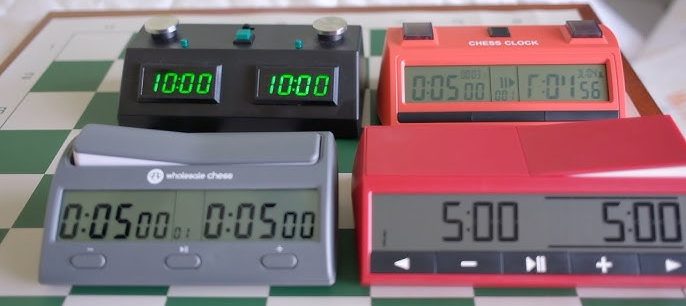
Chess clocks come with a variety of different displays and features. Some clocks have a simple LED display, while others have an LCD display with extra features such as a move counter and delay/increment options. You should always consider what features you want in a clock and choose a model with a display that suits your needs. Most tournaments these days have either a delay or an increment so getting a clock that supports both should be a no-brainer. If you don’t ever use then it’s no big deal and if you need it then at least it’s available. Also, a lot of longer (classical) chess tournaments do the multi-time controls so having a move counter is not a bad idea either. Most clocks also have some quick set features for common tournament time controls so this is also something to look out for.
Cost:
Chess clocks range in price from under $10 to $300 or more. Generally, you get what you pay for in terms of features and durability but a good clock with all the features you could ever need can be purchased for $30 – $60. There really are no chess clocks under $30 with the all functions a chess player could want so I would stay away from those. I also don’t see the need to spend $90 or $100 dollars or more on a chess clocks. Decide what your budget is and choose a clock that provides the features you want at a price you can afford.
Ease of Use:
Chess clocks should be simple to operate and understand, but most of them are anything but. one of the easiest clocks to set is the Tap N Set clock because it uses a phone that supports NFC to set the clock very easily. Any phone that has the functionality of tap and pay has NFC functionality. The tap n set can also be set manually without a phone but then it loses it’s primary benefit and becomes just as difficult to program as every other chess clock. Despite the easy of setting, I still don’t recommend the Tap N Set as my primary pick; see my article on the Wholesale Advanced vs Tap n Set.
Brand and Durability:
Chronos chess clocks have long been considered the “top brand” for chess clocks but personally I never got the hype. Don’t get me wrong, Chronos clocks are very durable (the case is made of metal), extremely reliable, and are great clocks, I just don’t like spending $110 for a chess clock when I can almost get 3 clocks just as good for the same price. DGT clocks are also a solid brand and have have almost replaced Chronos in the top spot for chess clock brands. Personally I don’t think you will go wrong with any brand but I would steer clear of a lot of the no-name amazon chess clocks.
Button Style:
Chess clocks can have any one of three primary button styles: the button, the touch, and the rocker. The button style is a physical button that you actually press down (think keyboard key). This style is the most tactile of the 3 and many people like it for the physical sensation and sound of actually pressing a real button. The button does have the drawback of being slightly less durable because buttons can break, but most button chess clocks use actual keyboard keys that are replaceable.. The touch style is a touch sensitive plate that does not physically move. This style is more durable because of the lack of moving parts but requires an actual finger to touch the pad; it won’t work my touching it with another object such as a chess piece. The rocker style is a very popular choice and you will see many of them at tournaments. The rock style combines the durability of the touch chess clocks with the physical movement. of the button clocks. However, one the main reason many people like this style is actually neither of those qualities but is because you can easily see from a distance whose move it is. This is good for people that like to walk around a lot during a chess tournament.
Chess Clock Recommendations
My go-to place for buying almost all my chess equipment is the US Chess Federation Shop. They regularly have sales and coupon codes for 10%-25% so be sure to look for that. There are some good clocks on Amazon too but you have to be much more careful because there is a lot of junk as well and most of the good stuff has actually just been the USCF selling their stuff on the Amazon marketplace under the House of Staunton name.
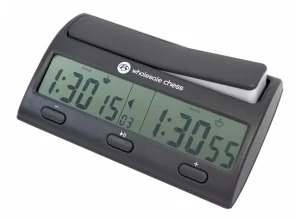
First Pick – Wholesale Advanced Clock
For most chess club members, the Wholesale Advanced Chess Clock is the better choice. Its durability, affordability, and comprehensive feature set make it ideal for both casual and competitive play. The rocker arm’s visibility and the clock’s ability to handle all USCF and FIDE time controls ensure it meets tournament needs reliably. While the Tap N Set’s smartphone app is a fantastic innovation for quick setup, its higher cost, questionable build quality, and occasional glitches make it less dependable, especially for serious tournaments. If you prioritize ease of setup and don’t mind the higher price and potential durability issues, the Tap N Set is worth considering, but for most players, the Wholesale Advanced offers the best balance of performance and value.
Price:
$30-$35 Depending on the discounts.
- There is also a nice zipper and cushioned bag option for an extra $5
- If you also need a chess set then I would suggest reading “How to Pick a Chess Set” before purchasing a clock because there are combo deals available.
Who/What is This For:
Someone needing a good quality chess clock at a decent price that has every feature a chess player could need.
Why We Like It:
This chess clock is the cheapest chess clock with advanced features on the market. It’s durable, has every feature you could want or need, and is approved your use in any US chess tournament.
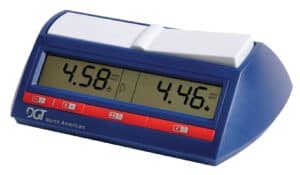
Second Pick – DGT North American
If you really like the rocker style chess clock, your phone doesn’t support NFC, or if you are buying for a child that will not have access to a phone, the DGT clock might be a better fit than my primary recommendation. This clock is not nearly as east to set as the Tap N Set but it does have 10 preset time controls and a “quick-set” feature.
Price:
$50-$62 Depending on the options.
- The only option for this clock is to get it in a non-standard color but the charge another $12 for that.
- If you also need a chess set then I would suggest reading “How to Pick a Chess Set” before purchasing a clock because there are combo deals available.
Who/What is This For:
Someone who wants a brand with a reputation among chess players for good quality and durability and is willing to pay extra for it.
Why We Like It:
The DGT chess clock has all the features any chess player could want or need at a good price. The rocker style of the DGT Clock provides the physically button feel in a durable form factor that has the added benefit of being easy to tell from a distance who’s move it is. If you go to any chess tournament, you will definitely see a lot of these clocks.